
The Illusion of Effort: Why AI Literacy is Incomplete
- Amy Fane Hervey

- Feb 28
- 7 min read
Updated: Mar 1
One of the most important numbers in marketing has nothing to do with revenue, margins, or market share. It is 5,127. That is the number of prototypes James Dyson built before he created the bagless vacuum cleaner. Four years. Five thousand, one hundred and twenty-seven failures.
Dyson's story everywhere. In his autobiography, on the website, in major news outlets, across every piece of communication the company produces. And the story works. People hear that number and they think, "The volume of effort that went into making this product must be extraordinary. The product must be extraordinary too."
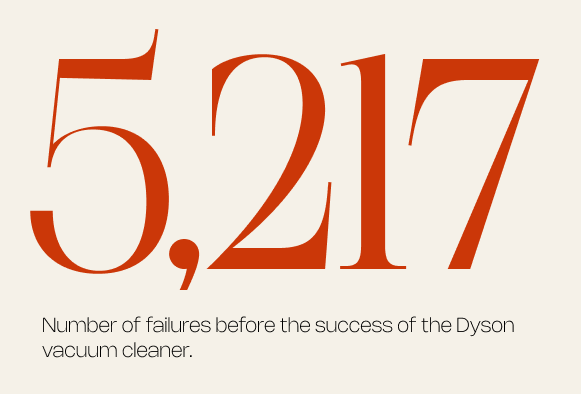
I first heard about the 5,127 prototypes during an economics class in a master's programme in 2016. And when I did, it wasn't a vacuum cleaner I wanted to buy. It was the Dyson hairdryer that was subsequently advertised to me. I had no evidence that Dyson, a manufacturer of vacuum cleaners, made superior hairdryers. I had not compared specifications or read reviews. I just remember thinking, "If that is the kind of care they put into a vacuum cleaner, imagine what they put into everything else." The story of effort in one product made me trust everything else they make.
From a purely logical perspective, how many prototypes Dyson went through is completely irrelevant. What should matter is how well the product works. How beautifully it is designed. How effectively it cleans your floor. But that is not how human beings evaluate quality. We evaluate based on the effort we perceive went into making it.
When I first read about the 5,127 prototypes, it wasn't a vacuum cleaner I wanted to buy. It was a Dyson hairdryer.
The effort heuristic
Psychologists call this the effort heuristic. Kruger, Wirtz, Van Boven and Altermatt published the foundational research in 2004 with an elegant experiment. Show people a poem and tell one group it took the poet eighteen hours to write, tell another group it took four hours. Same poem. The group that believed it took longer rated it meaningfully higher on quality. Effort became a proxy for worth.
If you have ever watched a travel website slowly cycle through "searching United... searching British Airways... searching 400 airlines," you have experienced this principle firsthand. Ryan Buell at Harvard Business School showed that people who watched a slow, animated search bar rated their flight results as significantly more comprehensive than people who received identical results instantly. Same outcomes. The only difference was the visible effort.
The illusions of labour
Buell and Norton formalised this idea in 2011, labelling it the illusion of labour: when people can see the work being done on their behalf, they value the outcome more, even when the result is identical. Someone worked hard for me. Therefore this must be valuable. And nowhere is this illusion playing out more powerfully than in the age of AI.
Searching, reading, synthesising
If you work with AI, or if you lead teams that use AI, you need to understand this principle of labour creating value. The smartest AI companies have already figured it out. Perplexity, for example, shows you "searching... reading... synthesising." That is the illusion of labour at work. When Claude displays its research steps, when deep research tools expose their reasoning chains, when AI agents show you the process rather than just the answer, they are making invisible effort visible. They are doing what Dyson does with transparent casing: letting you see the work so you perceive effort in the result.

These products understand something that most of us using AI have not yet internalised but that Dyson inherently understood. Humans need to see effort to believe in value. Even when the machine could deliver an answer instantly, showing the process builds trust.
The nefarious em dash
Those of you who have attended any of my AI Accelerators know that I have one strict rule. I ban the em dash. Not because it is grammatically wrong. It is perfectly correct punctuation. I ban it because it has become a social signal. Somewhere around early 2024, the em dash became one of those telltale markers that people associate with AI-generated text. Along with words like "delve" and phrases like "it's not X its Y," the em dash started triggering a allergic reaction in readers: a machine wrote this.
The irony is extraordinary. Human writers have used em dashes for centuries. Emily Dickinson built an entire poetic style around them. But once a punctuation mark becomes associated with perceived zero effort, it does not matter how legitimate its use is. The signal has been set. And in behavioural economics, signals matter as much as substance.
In behavioural economics, signals matter as much as substance.
Often without realising they are doing it, people are unconsciously scanning for cues. And every time they spot one and think "AI wrote this," the effort heuristic kicks in. Perceived effort drops. Perceived value drops with it.
Banning the em dash has nothing to do with grammar. It has everything to do with understanding how human beings evaluate quality. You can produce something genuinely excellent with AI, but if it carries the signals of effortlessness, people will value it less.
The antidote to slop is craft
The argument I want to make is not that you should stop using AI. That would be foolish. The argument is that using AI well is in itself a craft. And like any craft, it requires deliberate effort that most people are skipping.
My primary concern is that AI literacy is being taught as a purely technical skill. Learn the tools, understand context engineering, get you APIs right, understand RAG better. These are all necessary learnings. But taught in isolation they are dangerously incomplete. My belief is that behavioural economics must accompany AI learning (which is why this is deeply embedded in every course we run). If you learn to use AI without learning how people perceive AI, you will undermine the very value you are trying to create.
If you learn to use AI without learning how people perceive AI, you will undermine the very value you are trying to create.
What does it look like to use AI well?
I am deeply curious about this topic and an brushing up against this in all my work and so I will tell you what I do. When I use AI to help me write for example, I do not accept what it gives me. I argue with it. I tell it where it is wrong. I paste in my own well-formed thoughts, even if full of typos and incomplete sentences and I ask it for polish in specific cases and to point out flaws in my thinking. The result is messy. It takes much longer than most people expect. I genuinely labour with my tools, adding my own voice and style and imperfection and authenticity. I am thus augmenting my craft, not outsourcing it.
x3 personal tips to better show your effort
Show your thinking, including the parts that are not neat. When you share AI-assisted work with your customers or co-workers, do not present it as a finished product that appeared fully formed. Talk about the choices you made. "I started with three different angles and chose this one because..." or "The original structure was chronological but I reorganised it around the core argument because that is how I actually think about this problem." When people can see the decisions behind the work, they trust it. Not because the output is perfect, but because a human mind clearly shaped it.
Leave traces of your fingerprints on the work. AI produces clean, symmetrical, evenly weighted prose. Every paragraph roughly the same length. Every argument neatly balanced. That is precisely what makes it feel hollow. Your job is to break that symmetry. Add the aside that does not quite fit but reveals how you actually think. Include the caveat that a polished AI output would never include. Reference the specific conversation, the particular moment in a meeting, the thing your colleague said last Thursday that shifted your perspective. AI cannot do any of that. Only you can. Your imperfections are proof that a human was involved.
Show your imperfections. This might be the most counterintuitive thing I can say in a piece about quality especially because this is the part that is most difficult for me. We have been trained to believe that professional work should be flawless. Smooth. Polished to a shine. And AI is very good at producing that shine. But polished and trustworthy are not the same thing. A presentation with a handwritten annotation in the margin feels more credible than one with perfect formatting throughout. A proposal that includes the phrase "I am still working through this, but my current thinking is..." signals more effort, not less. It's why I am turning to video more and more because there is nowhere to hide your imperfections. The Pratfall Effect in psychology tells us that competent people become more credible when they show small imperfections. The same is true of competent work. Perfection, paradoxically, has started to signal that no one was really there.
The Pratfall Effect in psychology tells us that competent people become more credible when they show small imperfections.
Understanding signals
The oldest truth in craftsmanship has always been that visible effort creates perceived value. A hand-stitched seam. A signed painting. A number scrawled on the bottom of a ceramic bowl telling you it is one of forty. These signals predate behavioural economics by centuries, but the principle remains.
AI has not changed this truth. If anything, it has made it more urgent. We now live in a world where production is increasingly effortless and the perception of effort has become the scarce resource. And scarcity, as any behavioural economist will tell you, is where value lives.
Your honed craft is what will separate good work from everything else.
Take care of your craft.

