
Transformation Means Breaking the Old Shape
- Amy Fane Hervey

- Jan 26
- 3 min read
Updated: Jan 30
In theory, I'm supposed to be a transformation specialist. And yet I've developed a complete allergy to the word transformation.
When clients come to me looking for transformation, I always push back. I ask if that’s what they really want. Do they know that transformation is one of the most gut-wrenching and courageous undertakings of any leader’s career? Do they know that transformation requires deep leadership awareness and a willingness to let go of the words “that’s how we’ve always done it here?” Do they know that transformation requires breaking what exists before anything new can emerge?
The outcome of many of these conversations is that what leaders actually want is the less gruelling work of improvement. And that’s fine. Improvement is valuable work. But for a small handful of brave leaders, transformation is the path.
Transformation ≠ improvement
Transformation and improvement are fundamentally different things. Let me explain why. The word transform comes from the Latin transformare, which means to change shape. Not to polish. Not to accelerate. Not to upgrade. Not to improve. But to do the enormously difficult work of changing shape.
The word transform comes from the Latin transformare, which means to change shape.
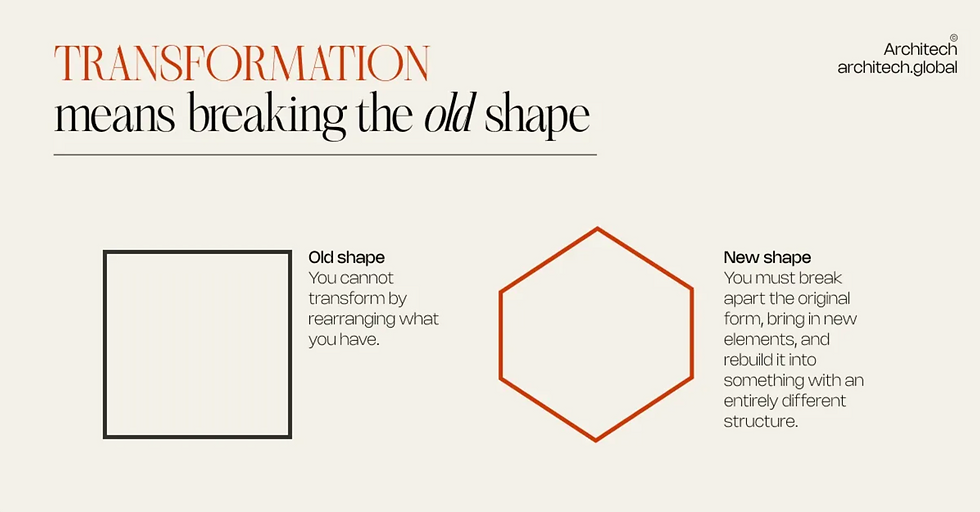
If you've ever tried to change the shape of something in your life (becoming a parent, stepping into a job you weren't ready for, starting your own business, learning something from scratch) you know the work of transformation. It's uncomfortable. It requires letting go of what used to work. Often things break. But if done right, transformation can a deeply rewarding experience.
This is exactly what AI demands of organisations. To transform. Because AI doesn't layer onto existing structures as a simple improvement. It ruptures them. It redistributes where expertise lives, reimagines how decisions get made and rewrites the fundamental economics of how value is created.
Proximity to power
Consider what happened when electricity arrived in factories in the early 1900s. For nearly a century, factories had been organised around a single steam engine with mechanical shafts distributing power through belts and pulleys. Every machine had to be positioned near the power source. The architecture of production was dictated by the limitations of steam. By providing an entirely new power source, electricity dissolved the proximity-to-power constraint entirely.
Small electric motors could now sit directly on individual machines. Factories could suddenly organise around workflow, around people, around logic rather than proximity to power. Ford's Highland Park plant used this to create the moving assembly line in 1913, something that would have been impossible with steam power. Entire industries like automotive manufacturing, which had been shaped by steam's limitations, transformed completely. New industries that had been impossible before became possible. Electricity didn't improve the old shape. It made entirely new shapes possible.
AI is doing this to organisations right now. Like electricity, AI changes where work happens, who does it, and how decisions are made. It shifts expertise from individuals to systems, memory from people to machines, coordination from hierarchy to networks and judgment from intuition alone to human-machine collaboration.
Dismantling the old structure
Because of AI, the old organisational structure cannot hold. No matter how much you polish or improve it, it becomes fragile. This is why so many AI initiatives stall. AI is a General Purpose Technology, like electricity was. And demands that organisations change shape, not just change speed. This mindset shift is one of the most essential elements of AI adoption.
Transformation is the willingness to break something
Transformation is not a project. Transformation is not a roadmap. Transformation is not business improvement either. Transformation is the willingness to let go of an old shape before the new one is fully clear. And for any reasonable leader, this is deeply uncomfortable. And yet, this is how organisations have always evolved when the world changed faster than their models.
AI will force every organisation to change shape. What matters is whether they do so intentionally.
